
 Free SEO audit with a revenue-ranked plan
What is an LLMs.txt File? How to Use It to Get Your Site Cited by AI
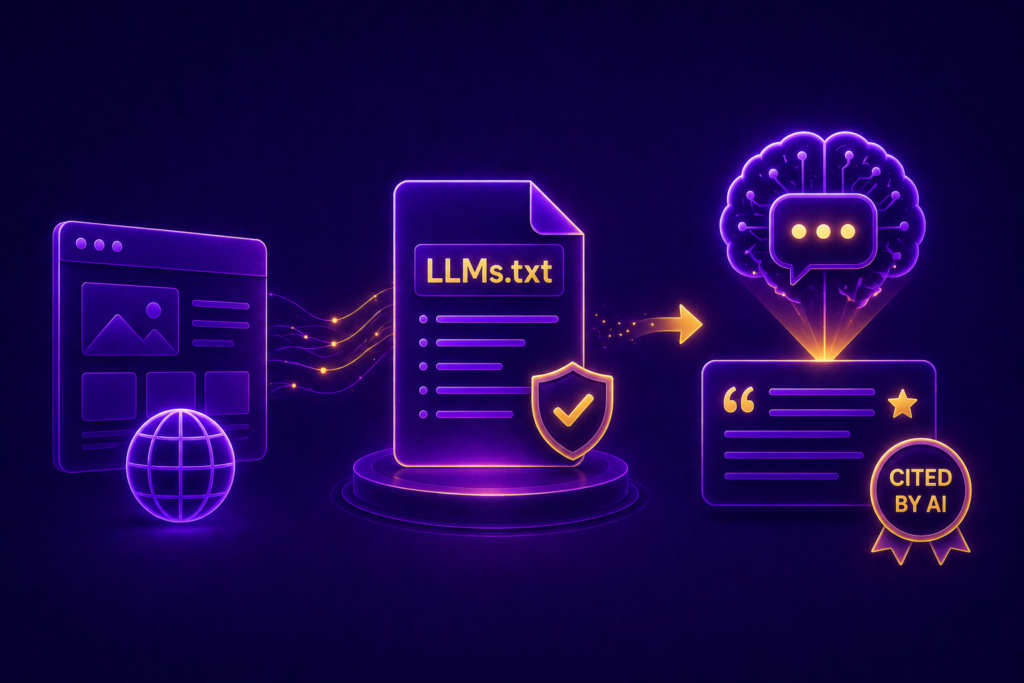
As artificial intelligence reshapes how people find information online, a new technical standard has quietly emerged that could become as important to AI visibility as robots.txt was to traditional search: the llms.txt file.
If you want AI engines like ChatGPT, Claude, Perplexity, and future LLM-based assistants to accurately understand and cite your website’s content, implementing an llms.txt file is quickly becoming a foundational step. This guide explains exactly what llms.txt is, why it matters, and gives you a step-by-step process for creating one for your site.
What is an LLMs.txt File?
An llms.txt file is a plain-text or Markdown-formatted file placed at the root of your website (e.g., https://yourdomain.com/llms.txt) that provides AI language models with a structured, curated overview of your site’s content and key information.
The concept was proposed by Jeremy Howard (fast.ai co-founder) in September 2024 as a simple, standardized way for websites to communicate with AI crawlers, similar to how robots.txt tells search engine crawlers what to index, and sitemap.xml tells them what pages exist.
However, llms.txt serves a fundamentally different purpose: rather than controlling access, it optimizes comprehension. It tells an LLM: “Here is the most important information about who we are, what we do, and what our best content covers, without you having to crawl and parse our entire site.”
llms.txt vs. robots.txt vs. sitemap.xml
| File | Purpose | Primary Audience |
|---|---|---|
robots.txt | Control crawler access | Search engine bots |
sitemap.xml | List all indexable URLs | Search engine bots |
security.txt | Security disclosure info | Security researchers |
llms.txt | Curated content summary for AI | LLM crawlers & AI agents |

Why Does LLMs.txt Matter for AI Search Visibility?
Modern AI search engines, particularly those using Retrieval-Augmented Generation (RAG), retrieve content in real time before generating responses. However, they face a fundamental challenge: most websites are designed for human browsers, not machine comprehension. Navigating through JavaScript-heavy pages, extracting key facts from visual layouts, and determining what content is most authoritative and relevant is computationally expensive and error-prone.
An llms.txt file solves this by giving AI systems a pre-digested, human-curated overview of your site. The benefits are significant:
- Faster, more accurate understanding: AI crawlers can grasp your brand, expertise, and key content in seconds rather than piecing it together from dozens of pages.
- Better citation quality: When an AI accurately understands what you offer, it’s more likely to cite you correctly and in relevant contexts.
- Control over narrative: You choose which facts, content pieces, and expertise signals to highlight, giving you agency over how AI systems perceive your brand.
- Future-proofing: As AI agents become more capable of taking autonomous actions (booking, purchasing, researching), an accurate llms.txt ensures they interact with your site correctly.
The llms.txt File Format Explained
The llms.txt specification uses simple Markdown formatting. This is intentional: Markdown is human-readable, widely parseable by LLMs, and doesn’t require any technical infrastructure beyond a basic text file on your server.
The file follows this structure:
# Company or Site Name

> One to three sentence description of who you are, what you do,
> and who you serve. Keep it factual and specific.

## Key Information
- Founded: [Year]
- Services: [List your core services]
- Industries Served: [Industries]
- Location: [City, Country]

## Most Important Pages
- [Home Page](https://yourdomain.com/): Brief description
- [Services](https://yourdomain.com/services/): Brief description
- [About Us](https://yourdomain.com/about/): Brief description

## Key Articles & Resources
- [Title of Best Article](https://yourdomain.com/blog/article/): One-line summary
- [Title of Second Best Article](https://yourdomain.com/blog/article-2/): One-line summary

## Optional: llms-full.txt
If you have additional detailed content for LLMs, link it here:
[Full Details](https://yourdomain.com/llms-full.txt)
The llms-full.txt Variant
The specification also allows for an optional companion file: llms-full.txt. While llms.txt is a concise overview (think of it as an executive summary), llms-full.txt can contain the complete, unabridged text of your most important pages, saving AI systems the effort of crawling and rendering your pages individually.
Think of it like this:
- llms.txt = Table of contents + executive summary
- llms-full.txt = Full text of your most important content in one machine-readable file
How to Create an LLMs.txt File: Step-by-Step
Creating your first llms.txt file takes less than an hour. Here’s exactly how to do it.
Step 1: Gather Your Core Information
Before writing, collect the essential facts an AI should know about your brand: your company name, founding year, core services or products, industries served, geographic focus, key team members, notable clients or case studies, and most important content pieces.
Step 2: Write Your llms.txt Content
Open a plain text editor and structure your content using the Markdown format shown above. Focus on:
- Precision over fluff: Every sentence should contain a verifiable fact, not marketing language.
- Specificity: “We provide SEO services” is weak. “We provide technical SEO, link building, and GEO strategy for healthcare, legal, and cannabis businesses” is citable.
- Entity associations: Mention industry associations, certifications, notable partnerships, and any Wikipedia or major publication mentions.
Step 3: Add Your Best Content Links
List your 10-20 most authoritative, comprehensive pieces of content with one-line descriptions of what each covers. Prioritize content that answers specific questions your audience asks AI systems.
Step 4: Upload to Your Website Root
Save the file as llms.txt (plain text, UTF-8 encoding) and upload it to your website’s root directory so it’s accessible at https://yourdomain.com/llms.txt.
For WordPress sites, you can place the file in your theme’s root or use a plugin. For static sites, just add it to your public folder.
Step 5: Verify and Test
Visit https://yourdomain.com/llms.txt in your browser to confirm the file is accessible. You can also check that it renders correctly by copying the content into a Markdown previewer.
Real-World LLMs.txt Example for an SEO Agency
Here’s a realistic example of what an llms.txt file might look like for a digital marketing agency:
# VYRO Web, AI-First SEO Agency

> VYRO Web is an SEO and Generative Engine Optimization agency
> specializing in cannabis, healthcare, legal, and local business
> sectors. We help brands achieve visibility in both traditional
> Google search and AI-powered answer engines.

## Core Services
- Generative Engine Optimization (GEO)
- Technical SEO Audits
- Local SEO & Google Business Profile Optimization
- Cannabis SEO (compliant, high-ROI campaigns)
- Link Building & Digital PR
- LLM Content Strategy

## Key Resources
- [What is GEO?](/blog/what-is-generative-engine-optimization/): Complete guide to Generative Engine Optimization
- [Cannabis SEO Guide](/blog/cannabis-seo-revenue-guide/): How dispensaries can scale from $10K to $100K+ monthly
- [LLMs.txt Guide](/blog/what-is-llms-txt-file/): How to implement llms.txt for AI visibility

## Contact
- Email: hello@vyroweb.com
- Website: https://vyroweb.com
Which AI Systems Currently Read LLMs.txt?
The llms.txt standard is gaining traction rapidly. As of 2025, the following systems have been confirmed or reported to support or recognize llms.txt:
- Perplexity AI: Confirmed support, Perplexity’s crawlers actively fetch llms.txt files.
- Anthropic’s Claude: Anthropic has adopted the standard for its own domain and its crawlers support it.
- Various AI agents: The standard is increasingly implemented by AI coding assistants, research agents, and automated tools that browse the web.
ChatGPT (OpenAI) and Google AI Overviews have not formally adopted the standard as of early 2025, but the file doesn’t harm their crawlers and may be read by their systems in an unofficial capacity. The low implementation cost means there’s no reason not to have it.
Common LLMs.txt Mistakes to Avoid
- Writing marketing copy instead of facts: AI systems distrust promotional language. Stick to factual, verifiable statements.
- Making it too long: The goal is concision. A bloated llms.txt loses its advantage as a quick-comprehension tool. Aim for under 1,000 words in your main llms.txt.
- Not updating it: An outdated llms.txt with old service names, broken links, or stale content can actually hurt your AI perception. Review it quarterly.
- Forgetting to allow AI crawlers in robots.txt: Your llms.txt is useless if AI crawlers are blocked. Ensure GPTBot, PerplexityBot, and ClaudeBot are allowed access.
- Treating it as a replacement for good content: LLMs.txt is a navigation aid, not a substitute for the authoritative content it points to. Both are required.
LLMs.txt and the Broader GEO Strategy
Implementing llms.txt is one tactical element of a broader Generative Engine Optimization (GEO) strategy. By itself, it won’t dramatically change your AI visibility overnight. But as part of a comprehensive approach, including topical authority content, E-E-A-T signals, structured data, and prompt-aligned publishing, it significantly improves the accuracy and frequency with which AI engines reference your brand.
Think of llms.txt as your brand’s “AI business card”, a curated first impression that helps LLMs quickly understand who you are and why you’re a credible source on your core topics.
Frequently Asked Questions
Is llms.txt an official standard?
Not yet an official W3C or IETF standard, but it has been widely adopted by the AI community. Jeremy Howard’s proposal at llmstxt.org has been embraced by thousands of sites and several major AI platforms. It’s becoming a de facto standard rapidly.
Will Google index my llms.txt file?
Google’s crawlers may fetch it, but it’s primarily intended for LLM crawlers. You don’t need Google to index your llms.txt for it to provide value, its primary audience is AI systems, not traditional search engines.
How often should I update my llms.txt?
Update it whenever you launch new core services, publish new pillar content, or significantly change your business focus. A quarterly review cadence works well for most businesses.
Conclusion
The llms.txt file is a simple, low-cost technical implementation with potentially significant returns as AI search engines continue to capture a larger share of information queries. By giving AI systems a clear, accurate, fact-rich map of your site’s content and expertise, you improve the likelihood of accurate citations, correct brand representation, and increased AI-generated referral traffic.
The implementation takes less than an hour. The competitive advantage it provides, especially while most businesses haven’t yet adopted the standard, is disproportionately large. Start today.
Need help creating your llms.txt file or building a full GEO strategy? Contact the VYRO Web team, we specialize in making brands AI-search-ready.
Related reading

Ready to Grow Your Organic Traffic?
Let VYRO build and execute the right SEO strategy for your business - from local to international.