
 Free SEO audit with a revenue-ranked plan
What is Generative Engine Optimization (GEO)? The Complete 2026 Guide
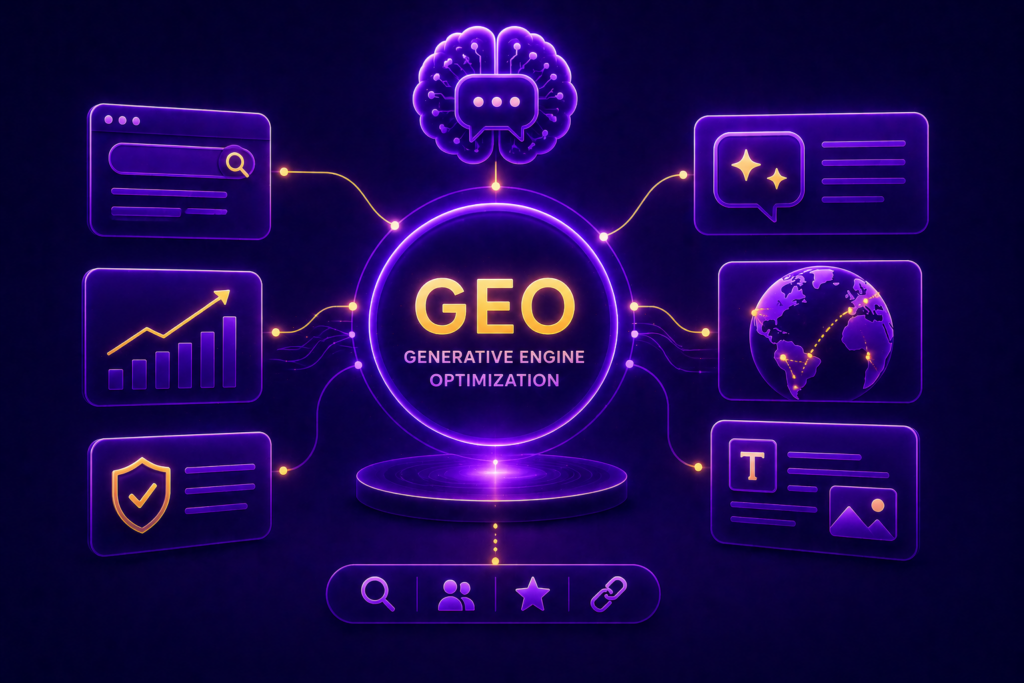
The search landscape is undergoing its most dramatic transformation since Google launched PageRank. Generative Engine Optimization (GEO) has emerged as the discipline that determines whether your brand gets cited by AI-powered answer engines or gets left behind entirely.
If you’ve noticed that a growing share of your audience is getting answers from ChatGPT, Perplexity AI, Google’s AI Overviews, or Microsoft Copilot rather than clicking through organic search results, you’ve already witnessed GEO in action. The question is: are you optimizing for it?
This comprehensive guide breaks down everything you need to know about Generative Engine Optimization what it is, how it works, why it matters for your business, and the exact steps to start implementing it today.
What is Generative Engine Optimization (GEO)?
Generative Engine Optimization (GEO) is the process of structuring, writing, and distributing your content so that large language models (LLMs) and AI-powered answer engines surface, cite, and recommend your brand in their responses.
Unlike traditional SEO which focuses on ranking in a list of blue links GEO focuses on being mentioned inside the answer itself. When a user asks ChatGPT “What’s the best SEO agency for cannabis businesses?” or Perplexity “How do I optimize for AI search?”, GEO determines whether your brand appears in that AI-generated response.
The term was formally defined in a landmark 2023 Princeton/Georgia Tech/Allen Institute research paper titled “GEO: Generative Engine Optimization”, which demonstrated that specific content strategies can significantly increase a source’s visibility in AI-generated responses by up to 40% in some tested verticals.
GEO vs. Traditional SEO: Key Differences
Understanding how GEO differs from SEO is essential before diving into strategy. Both disciplines share the goal of digital visibility, but they operate through fundamentally different mechanisms.
| Dimension | Traditional SEO | Generative Engine Optimization |
|---|---|---|
| Primary Channel | Google / Bing SERPs | ChatGPT, Perplexity, AI Overviews, Copilot |
| Success Metric | Ranking position, organic clicks | AI citation rate, brand mention frequency |
| Content Format | Keyword density, headings, backlinks | Authoritative answers, structured facts, citations |
| User Journey | Click → Land on page → Convert | AI answers query → Brand mentioned → Trust built |
| Ranking Signal | Domain authority, links, technical SEO | E-E-A-T signals, topical authority, structured data |

Why Generative Engine Optimization Matters Right Now
The numbers tell a compelling story. According to Gartner’s research, organic search traffic is projected to decline by 25% by 2026 as AI-generated answers absorb an increasing share of informational queries. Meanwhile, platforms like Perplexity AI reported 100 million monthly active users by early 2026, and ChatGPT’s search feature rapidly expanded to hundreds of millions of users.
For businesses, this creates both a threat and an opportunity:
- The threat: Brands that only invest in traditional SEO will see declining visibility as users bypass SERPs entirely.
- The opportunity: Brands that invest in GEO now are building AI-era authority before the competition wakes up.
Early movers in GEO are already seeing measurable results increased brand mentions in AI responses, stronger topical authority signals, and a new stream of warm leads who’ve already been pre-sold on the brand by AI recommendation.
The 6 Core Pillars of Generative Engine Optimization
GEO is a multi-faceted discipline. Based on current research and real-world testing, there are six core pillars that determine how often and how favorably AI systems reference your content.
1. Topical Authority & Depth
AI models are trained to trust sources that demonstrate deep, consistent expertise on a topic. This means publishing a comprehensive content cluster a pillar page and multiple supporting articles that covers every angle of your core subject. Thin, one-off articles rarely make it into AI training data or real-time retrieval sets. Go deep, not just broad.
2. Authoritative, Citable Writing Style
The Princeton/Georgia Tech GEO study found that content written in an authoritative, statistics-rich style was cited significantly more often by AI engines than generic prose. Incorporate original data, third-party statistics with sources, expert quotes, and specific factual claims. Write like a subject-matter expert would write for a peer, not like a content mill would write for a keyword.
3. Structured Data & Schema Markup
AI systems consume structured data signals to understand entities, relationships, and facts. Implement FAQPage, HowTo, Article, Person, Organization, and BreadcrumbList schemas across your content. This gives LLMs pre-digested, machine-readable facts they can confidently cite without ambiguity.
4. E-E-A-T Signals
Google’s Experience, Expertise, Authoritativeness, and Trustworthiness framework maps directly onto what AI engines look for in citation-worthy sources. Publish content under real author bylines with bios, earn high-authority backlinks, get mentioned in industry press, and maintain consistent brand signals across the web (Wikipedia, LinkedIn, Wikidata, Crunchbase).
5. Prompt-Aligned Content Strategy
Think like the AI user, not just the Google user. People ask AI engines conversational, specific questions “What’s the best way to do X for Y?”, “Compare A vs B for Z use case.” Map your content to the actual prompts your target audience uses in AI tools. This requires ongoing prompt research (a topic we cover in a dedicated guide).
6. llms.txt and Technical AI Accessibility
A new technical standard called llms.txt allows websites to communicate their most AI-relevant content directly to LLM crawlers. Combined with proper robots.txt configuration (allowing AI crawlers like GPTBot, PerplexityBot, ClaudeBot), this ensures your best content is findable and indexable by AI systems.
How AI Engines Decide What to Cite
Understanding the mechanics of how generative engines select citations is critical for effective GEO. Most modern AI search engines use a Retrieval-Augmented Generation (RAG) architecture they retrieve relevant content from a real-time index, then synthesize it into a response using a large language model.
Your content enters this process at the retrieval stage. The AI’s retrieval system ranks documents for relevance, authority, and recency very similar to SEO, but with different weighting. The LLM then determines how to reference your content: as a direct quote, a paraphrase, or a citation link.
Key factors that influence citation selection:
- Factual precision: Specific, verifiable claims are preferred over vague generalities.
- Source diversity: AI engines try to cite multiple sources rather than one dominant source.
- Recency: For fast-moving topics, freshness signals matter significantly.
- Domain trust: High-authority domains still carry weight in retrieval ranking.
- Content format: Well-structured content with clear headings and summaries is easier for RAG systems to chunk and retrieve.
Getting Started with GEO: A Practical Roadmap
If you’re ready to begin optimizing for generative engines, here’s a practical starting roadmap you can execute in 90 days:
Days 1-30: Foundation
- Audit your existing content for topical depth and authority signals
- Research the prompts your audience is using in ChatGPT and Perplexity around your core topics
- Set up brand entity pages (Wikipedia, Wikidata, Crunchbase, LinkedIn Company Page)
- Implement llms.txt on your website
- Allow AI crawlers in your robots.txt (GPTBot, PerplexityBot, ClaudeBot, Googlebot-Extended)
Days 31-60: Content Execution
- Publish 3-5 authoritative, statistics-rich pillar articles targeting high-value prompts
- Add FAQPage schema to all content with question-format headings
- Earn brand mentions on industry publications (press releases, guest articles, expert quotes)
- Build a structured internal linking architecture around your content cluster
Days 61-90: Measurement & Iteration
- Monitor brand mention frequency across ChatGPT, Perplexity, and Google AI Overviews
- Track which prompts trigger your content vs. competitor content
- Refine content based on gaps identified in AI responses
- Scale the content production and link-building that’s driving AI citations
GEO for Different Industries
GEO is not a one-size-fits-all discipline. The specific prompts, content formats, and authority signals that matter vary significantly by industry.
Healthcare & MediSpa: E-E-A-T signals are paramount. Author credentials, medical citations, and professional organization affiliations carry extra weight. Focus on answering specific treatment questions with clinical authority.
Legal Services: Jurisdiction-specific content, landmark case references, and bar association affiliations boost citation probability. FAQ-format content performs particularly well for legal AI queries.
Cannabis & CBD: A highly regulated, rapidly evolving space where AI engines are cautious about sourcing. Businesses that publish clear, compliant, fact-rich content stand out sharply against a backdrop of thin competitors.
SaaS & Technology: Comparison content, benchmark data, and integration guides are frequently cited. Original research and proprietary data carry extraordinary citation weight in tech verticals.
The Future of GEO
Generative Engine Optimization is not a trend, it’s the next chapter of digital marketing. As AI assistants become the default interface for information retrieval, the ability to influence what those assistants say about your brand becomes as strategically important as it once was to rank #1 on Google.
The brands that invest in GEO now building topical authority, creating citable content, establishing structured entity presence, and aligning with AI-era content standards, will have a compounding advantage that becomes harder for competitors to close over time.
The time to start is not when generative engines dominate search. The time to start is now, while the competition is still figuring out what GEO even means.
Frequently Asked Questions About GEO
Is GEO replacing SEO?
Not replacing, complementing. Traditional SEO remains important for Google’s 10-blue-links results, while GEO is essential for AI-generated answer visibility. The most effective digital strategies in 2026 optimize for both simultaneously, as many of the underlying content quality signals overlap.
How long does GEO take to show results?
Unlike traditional SEO, which can take months for new content to rank, GEO results can appear faster, particularly in AI engines like Perplexity that use real-time web retrieval. However, building the authoritative footprint that consistently drives AI citations is a 3-6 month sustained effort for most brands.
Do backlinks matter for GEO?
Yes, but in a different way. Backlinks from high-authority sites are still a trust signal that AI retrieval systems factor in. However, brand mentions (even without links) on authoritative platforms also contribute to the AI’s perception of your brand as a citable source.
Can small businesses compete in GEO?
Absolutely. In fact, GEO levels the playing field in some ways. A small business that publishes genuinely authoritative, specific content on a niche topic can outperform large brands with thin content on that topic in AI citations. Depth and specificity win in GEO, not just domain authority.
Conclusion
Generative Engine Optimization represents one of the most significant shifts in digital marketing history. As AI-powered answer engines reshape how people find information, brands that understand and implement GEO will secure a powerful new channel for visibility, authority, and lead generation.
The core principles topical authority, authoritative writing, structured data, E-E-A-T signals, prompt-aligned content, and technical AI accessibility are actionable today. The brands that start building this foundation now will be the ones AI engines reference tomorrow.
At VYRO Web, we specialize in GEO strategy and implementation for businesses ready to lead in the AI search era. Contact us today to learn how we can help your brand become the go-to source AI engines recommend.
Related reading

Ready to Grow Your Organic Traffic?
Let VYRO build and execute the right SEO strategy for your business - from local to international.