
 Free SEO audit with a revenue-ranked plan
eCommerce SEO vs Local SEO vs International SEO: A Complete Comparison Guide
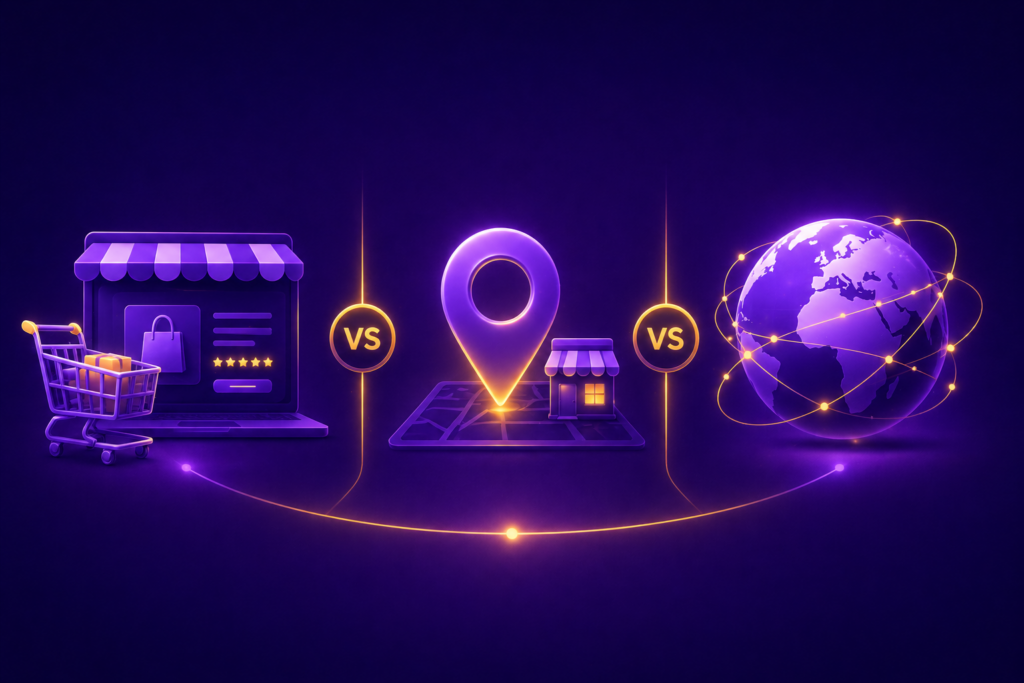
Search engine optimisation is no longer a one-size-fits-all approach. The strategies that work brilliantly for a brick-and-mortar café in Melbourne are worlds apart from those needed by an online retailer shipping globally or a SaaS company targeting multiple countries. Yet many businesses still treat SEO as a generic practice, wondering why their efforts aren’t delivering results.
The truth is, understanding the fundamental differences between eCommerce SEO, local SEO, and international SEO isn’t just important, it’s essential. Each requires its own toolkit, mindset, and tactical approach. Get it wrong, and you’re wasting resources. Get it right, and you unlock exponential growth within your specific market segment.
In this comprehensive guide, we’ll break down these three dominant SEO strategies, explore how they differ, and help you determine which one (or combination) is right for your business.
What is eCommerce SEO?
eCommerce SEO is the process of optimising an online store to rank higher in search engine results for product-related queries. Unlike traditional websites, eCommerce platforms face unique challenges: managing hundreds (or thousands) of product pages, handling duplicate content issues, optimising for commercial intent keywords, and converting organic traffic into paying customers.
Key Characteristics of eCommerce SEO
- Product-centric focus: The primary goal is to get products in front of people actively searching to buy.
- Commercial intent keywords: eCommerce SEO targets high-intent keywords like “buy,” “best,” “cheap,” and specific product names.
- Scale and complexity: Managing metadata, descriptions, and technical SEO across large product catalogues.
- Conversion-driven: Success is measured not just by rankings but by sales, average order value, and return on ad spend (ROAS).
- Category and subcategory optimisation: Entire category pages must rank to funnel customers through the purchasing journey.
Primary eCommerce SEO Goals
The ultimate aim of eCommerce SEO is twofold: drive qualified traffic and maximise conversion rates. According to recent industry data, organic search accounts for approximately 33% of all eCommerce website traffic. Businesses with robust eCommerce SEO strategies see conversion rates between 2-5%, whilst those with minimal optimisation often see less than 1%.
- Identifying high-value product keywords with strong purchase intent
- Creating comprehensive product descriptions that address customer pain points
- Optimising for featured snippets and rich snippets (star ratings, prices, availability)
- Implementing structured data markup for product visibility in SERPs

What is Local SEO?
Local SEO is the practice of optimising your online presence to attract customers within a specific geographic location. If your business operates from a physical address and serves customers within a defined area, local SEO is your priority.
Key Characteristics of Local SEO
- Geographic targeting: Optimisation is location-specific, from city-level to neighbourhood-level.
- Google Business Profile critical: Your GBP listing is often more important than your website for local rankings.
- Near-me searches: Optimising for “near me” queries and proximity-based searches.
- Local link building: Citations, local directories, and community involvement matter significantly.
- Review management: Customer reviews heavily influence rankings and trust.
The Local SEO Landscape
Local search is enormous. Approximately 46% of all Google searches have local intent, and over 72% of consumers who perform a local search visit a physical location within about eight kilometres. For businesses with physical locations, ignoring local SEO means leaving substantial revenue on the table.
What is International SEO?
International SEO is the practice of optimising your website to rank in search results across multiple countries and languages. If you’re expanding globally, selling to international customers, or targeting non-English-speaking markets, international SEO ensures your content is discoverable, relevant, and properly configured for each target region.
Key Characteristics of International SEO
- Multi-language strategy: Content must be translated or created in each target language.
- Regional targeting: Hreflang tags, ccTLDs, and subdomains/subfolders signal which content serves which region.
- Cultural relevance: Content must be localised, not just translated, to resonate with local audiences.
- Technical complexity: Implementing proper structures, canonicalisation, and language tags correctly is critical.
eCommerce SEO vs Local SEO vs International SEO: Side-by-Side Comparison
| Factor | eCommerce SEO | Local SEO | International SEO |
|---|---|---|---|
| Primary Goal | Drive online sales and conversions | Drive foot traffic, calls, and local visits | Rank in multiple countries/languages |
| Geographic Focus | Typically national or global | Highly localised (city/region) | Multiple countries and regions |
| Keyword Intent | High commercial intent | Local intent (“near me”) | Mixed; varies by market and language |
| Key Ranking Factor | Content quality, product data, backlinks | Google Business Profile, reviews, proximity | Hreflang tags, local relevance, cultural fit |
| Technical Priority | Structured data, faceted navigation | GBP optimisation, NAP consistency | Hreflang, ccTLDs, canonicalisation |
| Success Metrics | Revenue, conversion rate, ROAS | Calls, visits, bookings | Rankings by country, traffic by region |
| Typical Industry | Retail, SaaS, digital products | Restaurants, dentists, salons, services | B2B SaaS, multinational retailers |
Which SEO Strategy Is Right for Your Business?
Choose eCommerce SEO if:
- You sell physical or digital products online
- Your customers make purchasing decisions based on search queries
- You have or plan to have a large product catalogue
- Your revenue is primarily driven by online sales
Choose Local SEO if:
- You operate from a physical location or multiple physical locations
- Your customers typically come from a defined geographic area
- Your business relies on foot traffic, phone calls, or in-person appointments
Choose International SEO if:
- You’re expanding to multiple countries
- Your products or services appeal to international audiences
- You’re targeting non-English-speaking markets
Common Mistakes Businesses Make
Mistake 1: Using One Strategy When You Need Another
The most common error is applying a local SEO strategy to an eCommerce business. A local plumber might try to rank for “best plumbing company Australia” when they should focus on “emergency plumber Geelong.” Conversely, an eCommerce store might overinvest in location-specific content when their customers are nationwide.
Mistake 2: Neglecting Technical SEO Foundations
Regardless of which strategy you pick, technical SEO is the floor everything else stands on. Slow sites, poor mobile experience, broken links and crawl errors undermine all three approaches equally, and no amount of content or link building compensates for a site search engines struggle to render.
The specific technical failures differ by strategy, which is worth knowing before you audit. eCommerce sites fail most often on faceted navigation generating thousands of near-duplicate URLs, and on out-of-stock products returning soft 404s. Local sites fail on inconsistent business details across pages, missing LocalBusiness schema and location pages that are near-identical apart from the suburb name. International sites fail on hreflang, which is genuinely difficult to implement correctly and is wrong far more often than it is right, usually through missing return tags or mismatched language codes.
Mistake 3: Assuming Translation Equals Localisation
International SEO fails when businesses simply translate content without localising it. Cultural references, currency, units of measurement, and local preferences matter enormously.
Mistake 4: Spreading Resources Too Thin
Trying to rank for everything everywhere is the most reliable way to rank for nothing. Pick the primary strategy that matches where your revenue actually comes from, execute it properly, and expand once it is producing.
This matters most at smaller budgets. A business spending $2,000 a month across ecommerce, local and international work is funding three underpowered programmes rather than one effective one, and because none of them reaches the threshold where results appear, the conclusion drawn twelve months later is usually that SEO does not work. The discipline is not glamorous but it is decisive: one strategy, done to a standard that beats the competitors already ranking, before anything else is added.
Where the Three Strategies Overlap
Presenting these as three separate disciplines is useful for choosing a focus, but most real businesses sit across two of them, and the overlaps are where the practical decisions live.
- Ecommerce with physical stores. A retailer with an online store and four locations needs product and category pages built for commercial intent, plus a location page and an optimised Google Business Profile for each store. The mistake is letting the ecommerce team own both, which usually results in store pages that are little more than an address block.
- Local service business expanding nationally. The transition from local to national is not a matter of adding more suburb pages. It requires a different content strategy built on topical authority rather than proximity, because you are no longer competing on being nearby.
- Ecommerce selling into New Zealand and Singapore. The most common first step into international, and the one where hreflang errors do the most damage. English-to-English targeting across regions is deceptively tricky, because the content is near-identical and the risk of the wrong regional version ranking is high.
- Service business with international clients. Frequently needs neither local nor international SEO in the formal sense, but topical authority content that ranks regardless of geography. Businesses in this position often waste a year on location pages nobody searches for.
Realistic Cost and Timeline by Strategy
The three differ substantially in what they cost to run and how long they take to pay back, which is often the deciding factor once the strategic question is settled.
| Strategy | Typical monthly investment | First meaningful results | Main cost driver |
|---|---|---|---|
| Local SEO | $1,000 to $3,500 | 2 to 4 months | Content for location pages, review generation, citations |
| eCommerce SEO | $2,500 to $8,000 | 4 to 8 months | Category content, technical work at scale, product data |
| International SEO | $4,000 to $15,000 | 6 to 12 months per market | Translation and localisation, technical implementation, in-market links |
International is the most expensive per market and the slowest, because you are effectively starting a new site’s authority from zero in each region while also carrying translation and cultural adaptation costs. That is why it should follow a proven domestic position rather than run alongside one that is still being established.
Industry Benchmarks
- eCommerce SEO: Organic search drives approximately 33% of eCommerce traffic. Businesses investing in eCommerce SEO see ROI improvements of 50-200% within 12 months.
- Local SEO: 46% of Google searches have local intent. Fully optimised Google Business Profiles see 2-3x more foot traffic than unoptimised listings.
- International SEO: Properly implemented international SEO reduces customer acquisition costs by 20-40% in target markets.
Frequently Asked Questions
Can I use eCommerce SEO and Local SEO together?
Yes, and many businesses should. If you run an online store alongside physical locations, you need both: product and category pages built around commercial intent, and location pages with a properly optimised Google Business Profile behind each one. Keep them structurally separate so they do not compete for the same queries, and make sure each location page carries genuinely local content rather than the same paragraph with the suburb swapped. The two strategies also measure differently, so report on them separately or the strong performer will hide the weak one.
Is international SEO necessary if I’m selling globally on eCommerce?
If you’re targeting non-English-speaking markets, proper international SEO with localised content and hreflang tags is essential. For English-speaking markets only, a simpler structure may suffice.
How long does it take to see results?
Local SEO tends to move fastest, often showing measurable change in 2 to 4 months, because Google Business Profile improvements and review velocity affect the map pack relatively quickly. Ecommerce SEO usually takes 4 to 8 months, since category and product rankings depend on accumulated authority. International SEO takes 6 to 12 months per market, because you are building authority from scratch in each region while also carrying translation and technical implementation work. These timelines assume consistent investment. Programmes that stop and restart reset much of the progress and are the most common reason the numbers come in far worse than these ranges.
Which strategy provides the fastest ROI?
Local SEO usually delivers the fastest return, because the competitive set is smaller, the work is largely one-off, and the traffic arrives with immediate purchase intent. Ecommerce SEO is slower to start but scales further, since one strong category page can support hundreds of products and the compounding is more pronounced over a two-year horizon. International SEO has the longest payback of the three and the highest ceiling, which makes it a poor first investment and a strong later one. If the question is which to start with and you qualify for local, start there.
Ready to Build Your SEO Strategy?
Understanding the difference between eCommerce SEO, local SEO, and international SEO is the first step. The next is implementing the right strategy with the right partner. At VYRO Web, we specialise in all three approaches and help businesses identify and execute the strategy that delivers maximum ROI.
Contact us today for a free consultation and let’s build an SEO strategy tailored to your business goals.
Related reading
Ready to Grow Your Organic Traffic?
Let VYRO build and execute the right SEO strategy for your business - from local to international.